
Gone Batty
Day 2 of the National Pekapeka Hui

After a long first day, which ended in a pekapeka quiz over dinner, a good sleep was welcomed. The next morning it was up to an early alarm and back out to the Pekapeka Hui HQ for a second day of connections and learning.
Day two was heavily focussed on research. A key opening message was, when starting out with research, it’s important to think about what you’re trying to find out or achieve, and ensure that the methodology you are using will achieve that (rather than fitting the outcome to the methods you would like to use). A high level of variability in the resulting data will require more samples to reach a conclusion, while a smaller sample size is more likely to show no effect.
Acoustic or audio lures can be used to lure pekapeka into mist nets, in the same way that birds like kōkako can be caught. Initially this was trialled with European bat calls in Aotearoa, which were successful, but native pekapeka calls resulted in a higher frequency of catches. However, no matter the origin of the bat call used, the volume of catches didn’t really change, and the researchers speculated that this might be because once you catch your first pekapeka, it is likely to call others in. Pekapeka have different call types (e.g. distress, social, mating), so further research is required to identify what each of these sound like, and trial them for effectiveness. It was duly noted that it is important to avoid using distress calls in order to not stress pekapeka out unnecessarily - animal welfare comes first.
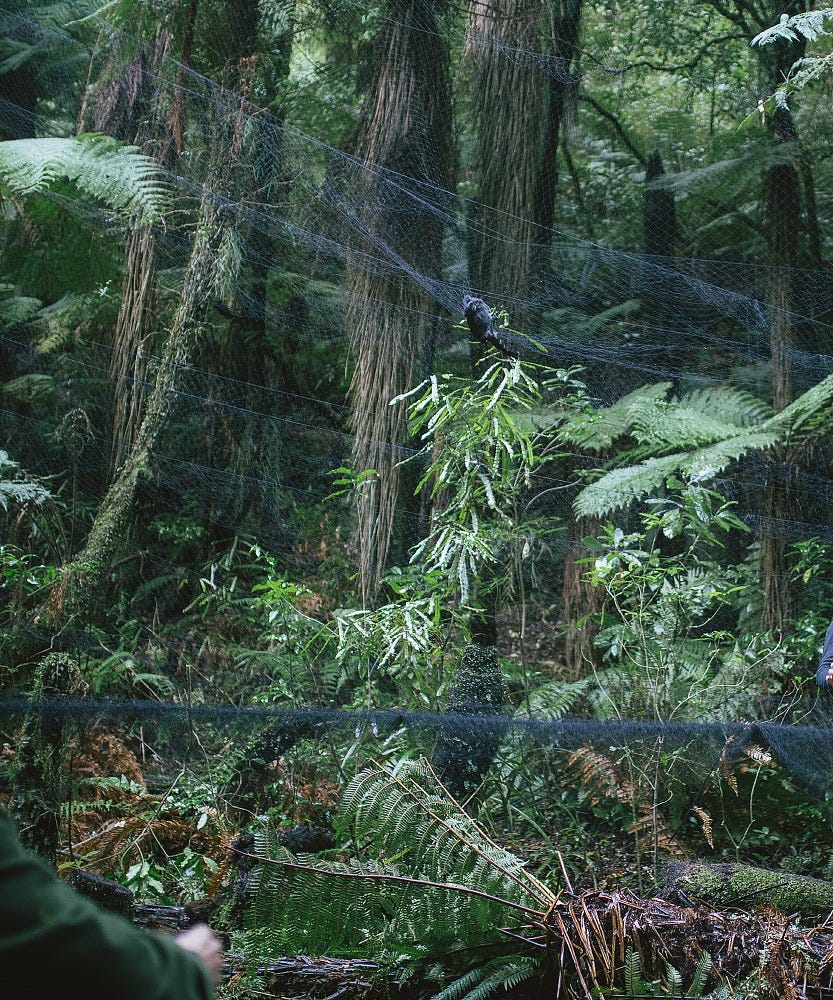
Further research presented at the hui included a study on ultrasound, which is used overseas to deter pest moths from crops by mimicking bats, but if it were to be used here, at what cost to our pekapeka and native insects? No impact was recorded on moths or pekapeka.
Knowledge gaps in pekapeka research were identified as:
Understanding of their landscape and habitat use
How to measure ‘success’ – what are the parameters of ‘success’ in pekapeka conservation, and can we standardise them across different pekapeka conservation projects in order to be comparable?
Predator control targets for successful breeding and population growth
Understanding true pekapeka distribution across Aotearoa
Understanding the barriers for colony and habitat connectivity, and as a result, what resources are needed, and where?
There was a fantastic suggestion to refocus the research questions to contribute to solutions for the broader question of ‘What conservation outcomes do we want for bats?’
The hui then moved on to some of the human-induced threats to pekapeka populations, such as the effects of artificial light on Long-Tailed bats. The spread of artificial light is increasing, but the quality is also changing thanks to the transition to LEDs, including in vehicle headlights. The light spectrum used now does affect wildlife, but comparatively and as a control measure, the lunar phase was not observed to affect pekapeka activity. White light resulted in decreased pekapeka activity, while amber light is better, and no light is best. To mitigate artificial lighting effects, we can use lights that operate at the amber end of the scale (which coincidentally is also better for humans).
Another study looked at Long-Tailed bat diet in pine plantations using eDNA in scat. 3,000 different taxa were detected in the eDNA, with 1,027 identified to species level. Mostly these were butterflies and moths, followed by flies and beetles. Approximately 20% were native insects, and 40% non-native including pest species, while the rest could not be identified closely enough to categorised. It appeared that lactating females went for energy dense prey, while males mostly ate moths. There were no real changes in dietary habits pre- and post-pine plantation harvest, indicating that pekapeka-tou-roa are highly adaptable.
Pekapeka use different types of roosts for socialisation, protection, and reproduction. The roost microclimate is important for roost selection, such as during torpor when their metabolism slows down during cooler months. Shivering to come out of torpor costs energy, so being in a warmer roost for passive warming is useful. Males and non-reproductive females may favour thermally unstable roosts as this helps during torpor. Reproductive females use torpor less, so favour more thermally stable roosts.
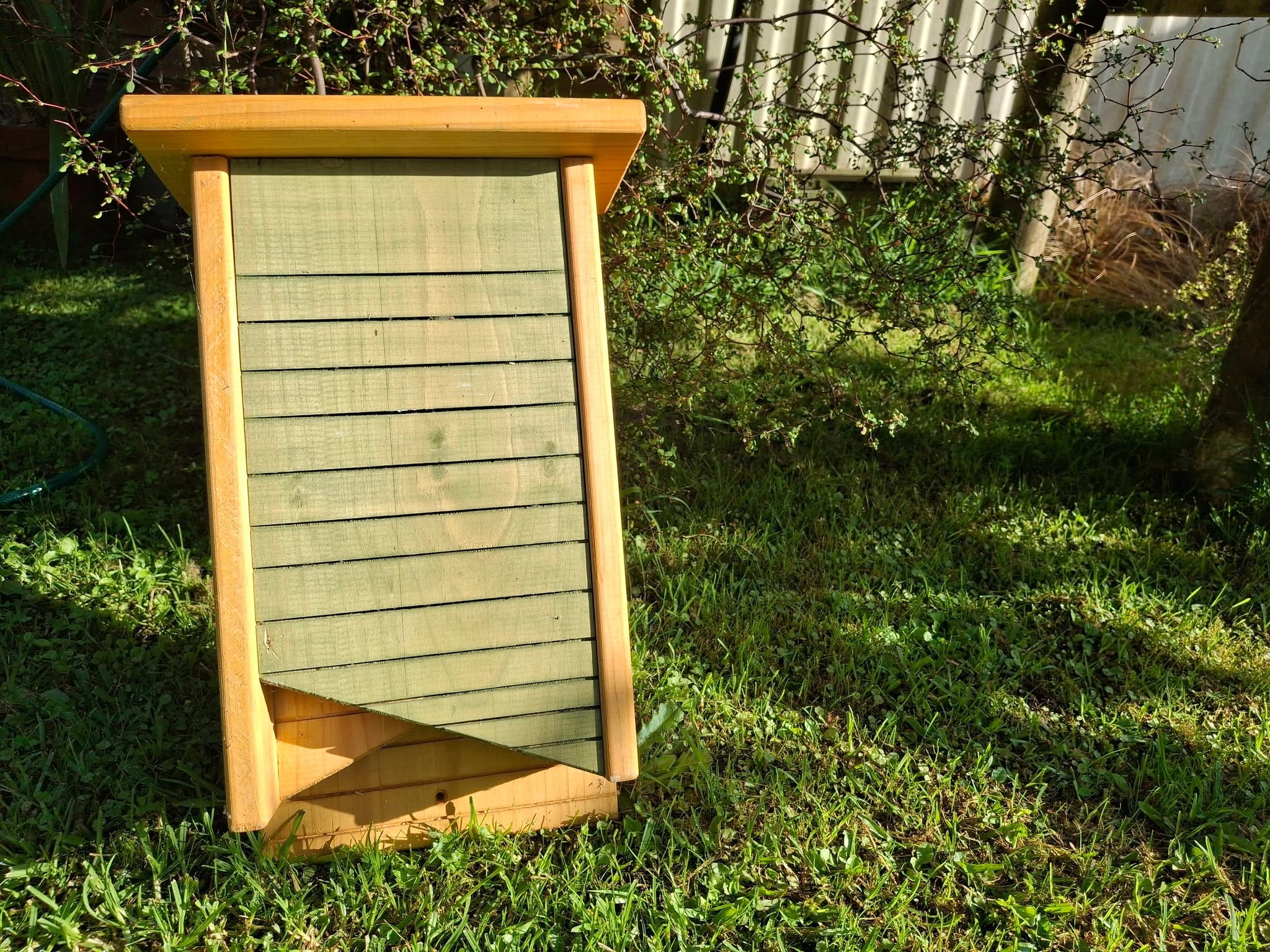
In some places, artificial bat boxes are installed to mitigate loss of tree cavities used for roosts, however there are some concerns around overheating when boxes get above 40oC. Pekapeka do use these exposed boxes, but seem to know to avoid them in the summer when they reach higher temperatures.
Although Long-Tailed bats do use bat boxes, their microclimate preferences have not been assessed. Artificial boxes are less insulated to temperature changes during the day, but pekapeka do not seem to mind. The resulting advice was to continue to install bat boxes where necessary to provide additional roosting sites where natural environments are being modified, but to install them in a range of microclimates so that bats can choose which they prefer, in the absence of humans understanding their preferences.
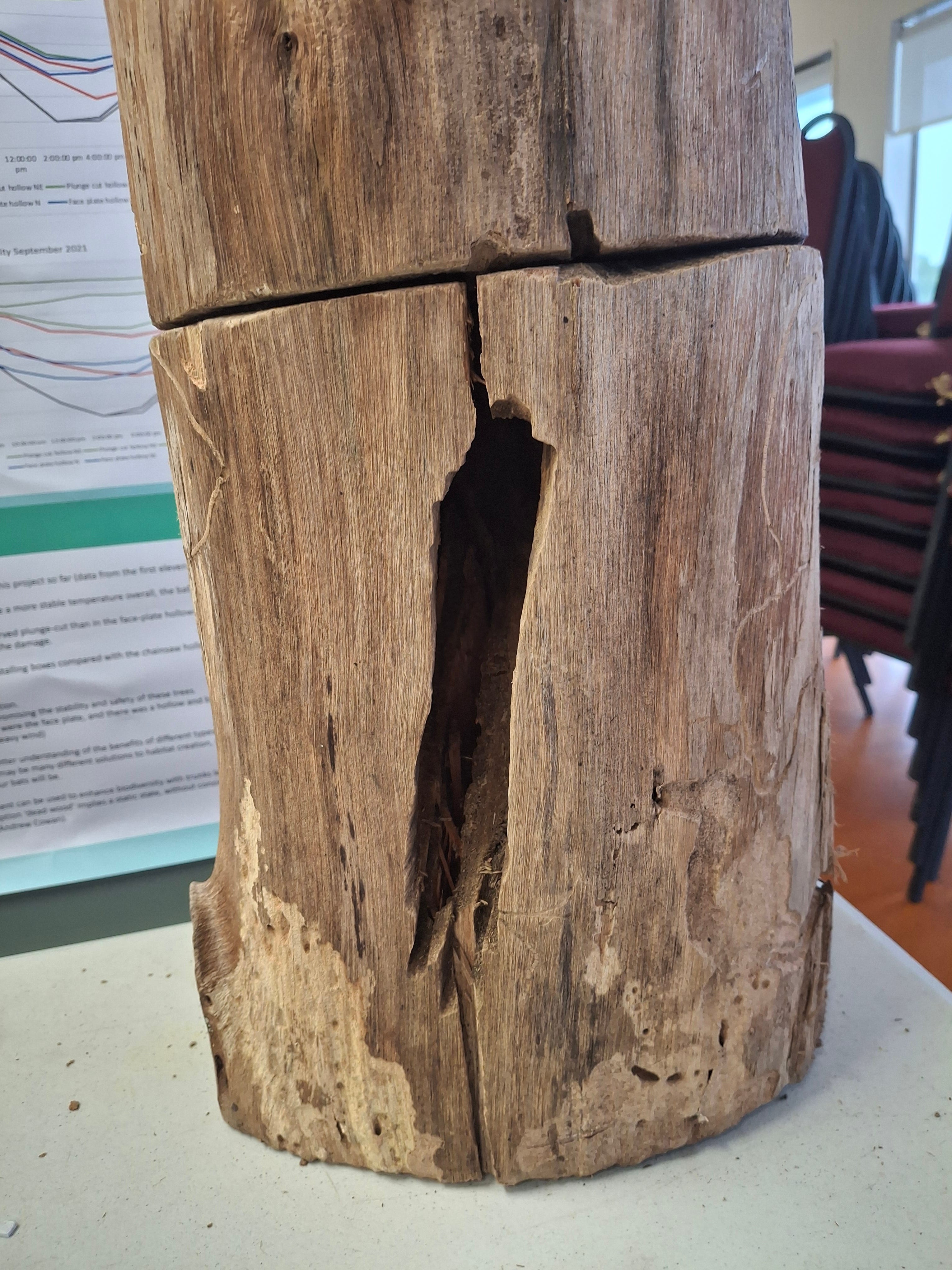
Bat roosts can be created in tree stumps by sawing a hole in tree stumps or trunks. This provides temporary biodiversity support while other native plants grow, and can be created by arborists in pest trees, eucalypts or pines.
In pekapeka populations, wind energy fatalities are caused by turbine collisions and barotrauma. Pekapeka appear to be disproportionally affected by wind turbines, with fatality levels high enough to cause full extinctions if we are not careful. Exactly why is not well understood, but they seem to be attracted specifically to turbines (possibly attracted to ‘big white glowy thing’, leading to males increasing their calls, attracting females, and leading to further collisions and death). Across the world, most impacted species of bat are from one superfamily, which unfortunately includes our native Long-Tailed bats.
The question therefore arises: how many bats need to die for us to be concerned, based on fisheries-style calculations? We do not monitor these fatalities enough to begin to answer this question, so bat detection dogs will come in handy to begin to understand the impact. However, there are solutions to this issue - we just need to find the balance. Examples of solutions include curtailment of wind farm use seasonally, with the weather or time of day in response to energy demand etc.
Presenters from day 2 who take full credit for the research included here are Antoine Collet, Darryl MacKenzie, Ian Davidson-Watts, Jarod McTaggart, Naveed Akhter, Michael Jones, Paul Arthur and Jess Armstrong, Kerry Borkin, Nicholas Ling, Ashleigh Stanners, Carley Goodwin, Aimee O’Sullivan, Sophie Carr, Fredrik Hjelm and Stevie Florent.
Months later I continue to reflect on this event. The passion in the room, the efforts to organise it, reconnecting with colleagues and meeting new ones, while also meeting people in person who I had only ever connected with online were so motivating and inspiring. We need to continue to provide spaces for people interested and invested in conservation to meet, share stories and ideas, and motivate and inspire each other. THAT is what will make these efforts succeed. The on-the-ground mahi (work) is secondary, and can fizzle out if we cannot maintain our drive to make the world a better place for our future generations.
Massive thanks to Finding Franklin Bats, Ecoquest, Predator Free Franklin and Auckland Council for providing this space in time for connection and passion.
A rock started a landslide.
Let’s be rocks.
Lenny